Master's Programme Computer Science
Overview
Degree | Master of Science |
Duration | 4 semesters |
Credits | 120 ECTS |
Language | German and English (certificates are required) |
Content | The programme is essentially a broad computer science Master's programme, but has distinctive interdisciplinary specialisations. It imparts the informatics basics to develop and maintain systems of software and hardware analytically, creatively and constructively. The methodical and analytical training combined with a broad spectrum of applications qualifies graduates of this degree for a field that is in high demand on the labour market and in science. |
Internationality | Stays abroad possible during studies |
Start | Summer and winter semester |
This programme offers you:
- Depending on your choice of focus, you will have strongly developed skills in Data Science, Artificial Intelligence, Algorithmics, Scientific Computing, Visual Analytics or Software Engineering. All of these areas are highly relevant and in demand in both academia and industry.
- The degree programme is characterised by great flexibility and choice. There is not a single compulsory course in the curriculum.
Structure
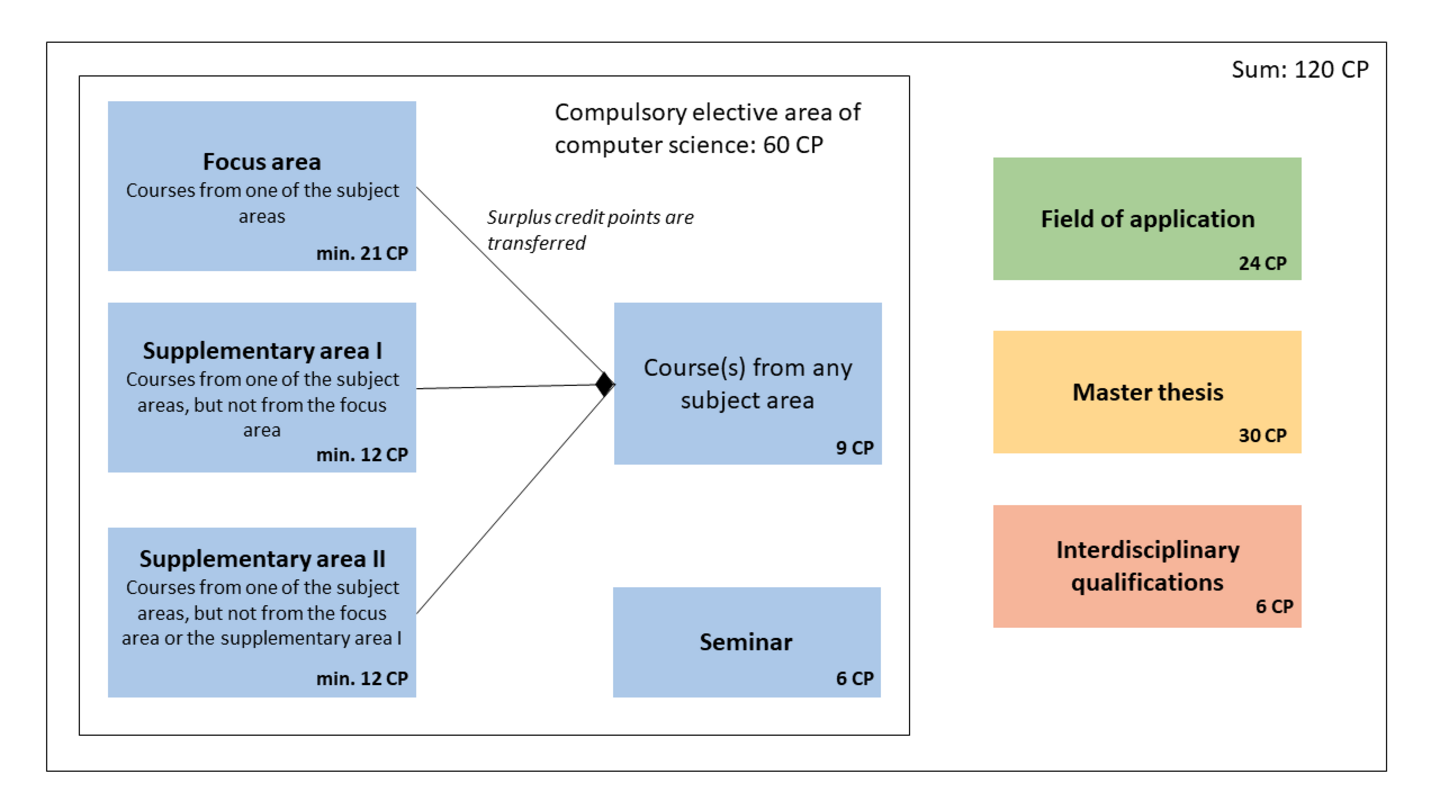
The structure of the degree programme is shown in the figure below. It is characterised by great flexibility and wide-ranging options for students. All courses in the compulsory elective area of computer science are assigned to a specific subject area (see below). The programme structure only stipulates that students must achieve a certain minimum number of credit points in individual subject areas. Students select one of the subject areas as their focus area. In the focus area, courses totalling at least 21 CP must be completed. Students select two further subject areas as supplementary areas to the focus area, in each of which they must complete at least 12 CP. This ensures a certain subject breadth within the scope of the informatics education. The study structure is completed by a seminar in computer science (6 CP), a Master's thesis (30 CP), interdisciplinary qualifications (6 CP) and the achievement of 24 CP in an application field (see below).
Subject areas
Subject areas structure the courses according to the content areas of computer science. A subject area can contain courses in different forms (lecture, tutorial, practical, project) and with different scopes. Currently there are the following subject areas:
- Algorithms and Theory
- Engineering of Software-Intensive Systems
- Artificial Intelligence and Visual Analytics
- Scientific Computing and High Performance Computing
Please refer to the module handbook for the specific courses in the subject areas.
Fields of application
The application field enables students to apply the computer science fundamentals in a concrete context and to use them creatively. Students must decide on one of the following fields of application when they start their studies and take courses there to the extent of 24 CP.
- Application field "Mathematics"
- Application field "Physics"
- Application field "Economics"
- Application field "Digital Humanities"
- Application Field "Computational Biology"
- Application area "Earth and Atmosphere"
Please refer to the module handbook for the specific courses in the application fields.
Interdisciplinary qualifications
In addition to the subject-specific content, students must take courses in the module "Interdisciplinary Qualifications" amounting to 6 CP, which cover relevant topics outside of the subject-specific expertise. For this purpose, students can choose from a catalogue of courses in the areas of entrepreneurship, philosophy of science, interdisciplinarity, ethics/philosophy and society. The module is ungraded.
Some of the courses recommended here can be found in the course plan of the masters programme in KLIPS. Students also have the opportunity of applying for credit for courses not listed in KLIPS for the "Interdisciplinary Qualifications" module. For this purpose, a request must be sent to the examination office. This also applies in particular to the courses offered by the ProfessionalCenter of the University of Cologne, which are listed in KLIPS as "Extracurricular Courses".
We look forward to receiving your application!
Access requirements
The programme is aimed at students with a Bachelor's degree in computer science or related courses.
The following contents must have been covered in the Bachelor's degree programme:
- Theoretical computer science (min. 15 ECTS)
- Mathematics (min. 18 ECTS)
- Programming, Software Technology, and Information Systems (min. 18 ECTS)
These minimum requirements are met by students of the University of Cologne in the Bachelor's degree programmes in Business Mathematics, Business Information Systems and Mathematics with a minor in Computer Science.
In Theoretical computer science, lectures include topics such as automata theory, formal language theory, computability and complexity theory, as well as logic, algorithms, or data structures.
In addition, the Bachelor's degree must have been completed with a grade of at least 2.5.
Since courses are offered in both German and English, applicants for the degree programme must provide evidence of both German language skills (DSH-2 or equivalent) and English language skills (level B2).
The examination board makes the necessary determinations and decides on possible exceptions. In particular, the Examination Committee may require that qualifications must be made up for.
Zulassungsverfahren: Numerus Clausus (NC)
Zusätzlich zu den festgelegten Zugangskriterien ist der Masterstudiengang Informatik zulassungsbeschränkt (gültig seit 03/25). Die Plätze werden nach dem Örtlichen Auswahlverfahren (örtlicher NC) vergeben. Dabei wird die Bachelornote herangezogen, nicht wie bei NC-Verfahren für Bachelorstudiengänge die Abiturnote. 80% der Plätze werden über die Hochschulquote der UzK, 20% über die Bachelor-Bestnote vergeben. Zusätzlich können bis zu sechs Wartesemester berücksichtigt werden. Informationen zum Örtlichen Auswahlverfahren bietet das Studierendensekretariat. Eine andere Möglichkeit, zum ersten Fachsemester zugelassen zu werden, gibt es nicht. Ausnahmen sind nur über Sonder- oder Härtefallanträge möglich, weitere Informationen finden Sie dazu hier. Die NC-Werte der letzten Jahre sind für zukünftige Auswahlverfahren nicht verbindlich, da sich der NC immer erst im laufenden Verfahren ergibt. Es ist allerdings davon auszugehen, dass sie sich in etwa bestätigen und nur wenig verändern werden. Grundsätzlich empfehlen wir aber, sich zu bewerben, da Sie nur im offiziellen Bewerbungsverfahren auch eine verbindliche Rückmeldung erhalten.
Application process and deadlines
- Application deadline for the summer semester: 15th of January
- Application deadline for the winter semester: 15th of July.
Applications are submitted via the campus management system Klips 2.0.
External applicants with a foreign Bachelor's degree also apply via Klips 2.0, but must apply for pre-examination documentation (VDP) via uni-assist and submit this in Klips 2.0.
Requirements
The following documents must be submitted:
- Proof of admission requirements
- Description of the (previous) course of studies (Transcript of Records)
- University entrance qualification
- External applicants must also submit the pre-examination documentation (VPD)
Further links
Orientation:
Application:
Dates:
FAQs zum Masterstudiengang Informatik
Die wichtigsten Fragen und Antworten im Überblick.
1. FAQs - Vor dem Studium
Wie bewerbe ich mich?
Die Bewerbung für den Masterstudiengang Informatik läuft über das Zentrale Studierendensekretariat der Universität zu Köln. Genaue Infos zum Bewerbungsprozess findest du hier.
Kann ich mich auf das Masterstudium Informatik bewerben, obwohl ich noch nicht mein Bachelor-Zeugnis habe?
Ja. Sobald Sie 80% der in Ihrem Bachelorstudium zu erbringenden Leistungspunkte erreicht haben (i.d.R. 180 LP * 0,8 = 144 LP), können Sie sich auf unser Masterstudium bewerben. Es gilt zu beachten: Als Note wird dann Ihr aktueller Notenschnitt herangezogen. Sollte sich die Note in Ihrem Abschlusszeugnis noch verschlechtern, so beeinflusst dies Ihre Bewerbung nicht. Sollte sich Ihre Note im Nachhinein noch von einer schlechteren Note als 2,5 auf mindestens die Note 2,5 verbessern, können Sie sich anschließend erneut auf unseren Master bewerben.
Für die inhaltlichen Zugangsvoraussetzungen der oben genannten Bereiche Theoretische Informatik (min. 15 ECTS), Mathematik (min. 18 ECTS), Programmierung, Software Technologie und Informationssystems (min. 18 ECTS) gilt: Unbeachtet vom Fortschritt Ihres Bachelorstudiums müssen zur Zeitpunkt der Bewerbung in allen drei Bereichen Leistungen im ausreichenden Umfang nachgewiesen werden.
Ich erfülle die oben genannten Zugangsvoraussetzungen nicht. Besteht die Möglichkeit, dass ich trotzdem einen Studienplatz erhalte?
Nein. Die oben genannte Mindestnote von 2,5 ist eine notwendige Voraussetzung und somit harte Zugangsbedingung. Es handelt sich hierbei nicht um einen NC-Wert mit Nachrückverfahren. Die genannten inhaltlichen Voraussetzungen in den Bereichen Theoretische Informatik (min. 15 ECTS), Mathematik (min. 18 ECTS) sowie Programmierung, Software Technologie, und Informationssystems (min. 18 ECTS) sind neben den genannten Sprachnachweisen in Deutsch (DSH-2 oder gleichwertig) und Englisch (Level B2) ebenfalls strikte Zugangsvoraussetzung. Ohne die entsprechenden Nachweise können wir Ihre Bewerbung auf unser Masterstudium leider nicht berücksichtigen.
Ich erfülle die oben genannten Zugangsvoraussetzungen nicht. Ist eine Zulassung unter Auflagen möglich?
Auch das ist leider nicht möglich. Zum Zeitpunkt der Bewerbung müssen Sie Leistungen in genügendem Umfang in allen drei oben genannten Bereichen vorweisen.
Es ist jedoch möglich, dass Sie die Leistungen nachholen, bevor Sie sich auf unser Masterstudium bewerben. Beachten Sie hierzu jedoch, dass das Ende der Bewerbungsfrist immer der 15. Januar und der 15. Juli ist, und somit kurz vor der Prüfungsphase des jeweiligen Semesters liegt. Leistungen, die Sie innerhalb eines Semesters erbringen, können Sie daher in der Regel erst zur Bewerbungsfrist für das übernächste Semester nachweisen.
Aus welchen Lehrveranstaltungen besteht mein Studium und wie sind diese strukturiert?
Das Masterstudium Informatik besteht bei uns aus verschiedenen Lehrveranstaltungen: Vorlesungen, Übungen, Seminaren, Tutorien und Praktika. Detaillierte Informationen zum Studienaufbau und den Inhalten der Module finden Sie weiter oben auf dieser Seite oder im Modulhandbuch.
Vorlesung: Hierbei handelt es sich um die klassische Form des mündlichen Vortrags eines/einer Dozierenden. Studierende haben die Möglichkeit, Fragen zu stellen oder Notizen zu machen. Auch wenn in Vorlesungen teilweise 100 oder mehr Studierende sitzen, freuen sich die Dozierenden auch in Vorlesungen über eine aktive Teilnahme der Studierenden und gehen gerne auf Feedback oder Fragen ein. In den Vorlesungen im Bachelor Informatik herrscht keine Anwesenheitspflicht. Trotzdem ist es dringend empfohlen, die Vorlesungen zu besuchen und den behandelten Stoff wöchentlich nachzuarbeiten. Die meisten Vorlesungen finden in Präsenz statt. Teilweise finden Vorlesungen allerdings auch online, hybrid oder im sogenannten Flipped-Classroom-Format statt. Hierbei stellt der/die Dozierende die Vorlesung vorab als Video online und die Präsenzstunde im Hörsaal dient der Vertiefung: Es können Fragen gestellt oder Übungsaufgaben gemeinsam bearbeitet werden.
Übung: Übungen sind keine eigenständige Lehrveranstaltung, sondern finden immer in Begleitung einer Vorlesung statt. Sie werden in kleineren Gruppen abgehalten, so dass die Gruppengröße meist bei etwa 20 Studierenden liegt. Die Übungsstunden werden von Studierenden im höheren Semester gehalten, so dass eine familiärere Atmosphäre als in der Vorlesung besteht. In der Übung werden Aufgaben zur Vertiefung des Vorlesungsstoffes besprochen. Außerdem können Fragen zur Vorlesung gestellt werden.
Seminar: Seminare finden ebenfalls in kleineren Gruppen von maximal etwa 15 Studierenden statt. Ein Seminar besteht meistens aus einer Reihe von Vorträgen der Studierenden. Alternativ oder zusätzlich kann auch das Anfertigen einer Hausarbeit oder eines Software-Projekts verlangt werden. Das Thema des Seminars orientiert sich häufig nah an einer Vorlesung des/der Dozierenden. Daher empfiehlt es sich, ein Seminar erst im fortgeschrittenen Studium zu belegen, nachdem Sie schon einige Vorlesungen besucht haben und vielleicht schon herausgefunden haben, welche Themen Sie besonders interessieren.
Tutorium: Tutorien werden nur in manchen Anwendungsfeldern, vor allem in Wirtschaftswissenschaften und Volkswirtschaftslehre angeboten. Ähnlich zu Übungen finden diese vorlesungsbegleitend statt und dienen der Vertiefung des Vorlesungsstoffs. Im Gegensatz zu Übungen finden Tutorien allerdings zentral statt, d.h. es gibt nur einen Termin pro Woche, so dass die Gruppengröße der Größe der Vorlesung entspricht. Der/die Tutor/in ist außerdem meist kein/e Studierende/e, sondern ein/e Assistent/in der/des Dozierenden.
Praktikum: Praktika sind ebenfalls nur in manchen Nebenfächern Teil des Studienprogramms, und zwar in den Fächern Physik, Computational Biology sowie Erde und Atmosphäre. Wie der Name schon sagt, wird hier vor allem angewandt gearbeitet. In der Physik und der Computational Biology geht es vor allem darum im Labor zu arbeiten, eigenständig Versuche durchzuführen und diese zu protokollieren. In der Erd- und Klimaphysik liegt der Fokus hingegen auf der Durchführung von Messungen und der Verarbeitung der gewonnenen Daten. Zu diesem Zweck können auch Exkursionen oder Feldversuche Teil der Praktika sein. Aufgrund der betreuungsintensität finden Praktika meist in kleinen Gruppen von nur 5 bis maximal 10 Studierenden statt.
Muss ich ein Anwendungsfeld wählen?
Ja, neben dem Hauptfach Informatik muss ein Anwendungsfeld gewählt werden. Es stehen die Fächer Mathematik, Physik, Wirtschaftswissenschaften, Volkswirtschaftslehre (VWL), Digital Humanities, Computational Biology sowie Erde und Atmosphäre als Anwendungsfeld zur Auswahl. Im Anwendungsfeld müssen 24 Leistungspunkte (ECTS) erbracht werden. Bei den Vorlesungen der Anwendungsfelder handelt es sich um Vorlesungen der anderen Fachbereiche, die Sie zusammen mit den Studierenden des jeweiligen Fachs besuchen. Die Liste aller zur Auswahl stehenden Veranstaltungen finden Sie in den Anhängen 2.A bis 2.G der PO Master Informatik sowie im Modulhandbuch in den Anhängen A.1 bis A.7.
2. FAQs - Während des Studiums
Wie melde ich mich zu Vorlesungen und Übungen an und welche Fristen gibt es?
Die Anmeldung zu Lehrveranstaltungen erfolgt grundsätzlich über KLIPS. Dazu loggen Sie sich in KLIPS 2.0 mit Ihrem Smail-Account ein und nutzen dann die Funktion "Studienstatus". Dort öffnet sich dann nach Anklicken Ihres Studiengangs Ihr Studiengangbaum. Sie wählen das entsprechende Modul, in dem Sie die Vorlesung belegen möchten. Die Standard-Module bestehen aus Vorlesung, Übung und Prüfung. Um die Lehrveranstaltung zu belegen, erweitern Sie die beiden Knoten „Vorlesung“ und „Übung“ und klicken jeweils auf das grüne „T“. Es öffnet sich ein Pop-up-Fenster, in dem Sie Ihre Anmeldung mit zwei weiteren Klicks bestätigen müssen. Der Knoten „Modulprüfung“ ist erst für die Anmeldung zur Prüfung am Ende des Semesters wichtig.
Die wie oben beschriebene Anmeldung zu Lehrveranstaltungen ist nur in den Belegphasen möglich. Es gibt vor jedem Semester mehrere Belegphasen. Die erste Belegphase für ein kommendes Semester beginnt immer schon gegen Ende der Vorlesungszeit des vorangehenden Semesters. Für ein Wintersemester also Mitte Juli und für ein Sommersemester Ende Januar/Anfang Februar. Die genauen Zeiträume der Belegphasen sind auf dieser Seite nachzulesen.
Aber keine Sorge: Für die Vorlesungen und Übungen im Fach Informatik gibt es für Masterstudierende der Informatik keine Kapazitätsbeschränkungen. Hier bekommen Sie also immer auch noch in der 2. Belegphase einen Platz.
Wie melde ich mich zu Prüfungen an und welche Fristen gibt es?
Die Anmeldung zu den regulären Semesterabschlussprüfungen erfolgt in der Regel - wie auch die Veranstaltungsbelegung - über KLIPS 2.0. Dazu loggen Sie sich in KLIPS 2.0 mit Ihrem Smail-Account ein und nutzen dann die Funktion "Studienstatus". Dort öffnet sich dann nach Anklicken Ihres Studiengangs Ihr Studiengangbaum. Sie wählen das entsprechende Modul, in dem Sie die Prüfung ablegen möchten und klicken dazu die entsprechende Modul- oder Lehrveranstaltungsprüfung an. Dort klicken Sie dann auf das "P". Es öffnet sich ein Pop-up-Fenster, in dem ggf. auch alternative Prüfungstermine angezeigt werden. Bei jedem Prüfungstermin steht, bis wann Sie sich an-/ beziehungsweise abmelden können. Das kann, je nach Prüfungstermin, variieren. Dort können Sie dann die endgültige Anmeldung vornehmen.
Für mündliche Prüfungen, die nicht in KLIPS angelegt sind, nutzen Sie zur Prüfungsanmeldung bitte das entsprechende Formular auf dieser Seite.
Die Anmeldephase für alle Prüfungen im Kernbereich Informatik beginnt vier Wochen und endet eine Woche vor dem jeweiligen Prüfungstermin.
Kann ich mir Leistungen von anderen Hochschulen oder aus vorherigen Studiengängen anrechnen lassen?
Grundsätzlich haben Sie die Möglichkeit, sich innerhalb Ihres Studiums externe Leistungen anrechnen zu lassen. Es muss jedoch in jedem Einzelfall geprüft werden, ob das externe Modul sowohl in Inhalt als auch in Umfang passend und eine Anrechnung daher möglich ist. Einen formlosen Antrag auf Anrechnung können Sie unter Angabe folgender Informationen per Mail an anrechnung cs.uni-koeln.de schicken:
- Nennung des externen Moduls inkl. Modulbeschreibung und LP-Umfang
- Nachweis über erfolgreiches Absolvieren dieses Moduls (bspw. Transcript of Records)
- Angabe des Moduls, als welches das externe Modul anerkannt werden soll
Wie oft darf ich eine Klausur wiederholen, wenn ich durchgefallen bin?
Wenn Sie durch eine Klausur durchgefallen sind, weil Sie diese z.B. nicht bestanden haben oder verpflichtend angemeldet waren und nicht erschienen sind, erhalten Sie dafür einen Fehlversuch. Für die Module im Fachbereich Informatik gibt es allerdings keine Versuchsbeschränkung und somit auch keine maximale Anzahl an Fehlversuchen. Ausgenommen ist hierbei lediglich die Masterarbeit, für die die Anzahl der Versuche auf zwei begrenzt ist. Darüber hinaus bestehen nur in den Anwendungsfeldern Wirtschaftswissenschaften und Volkswirtschaftslehre Versuchsbeschränkungen. Die genauen Regelungen zu den Versuchsbeschränkungen in diesen Modulen sind in der Prüfungsordnung Master Informatik in den entsprechenden Anhängen 2.C und 2.D sowie in §20 nachzulesen.
Wenn ich durch eine Klausur durchgefallen bin, muss ich dann genau diese Prüfung wiederholen?
Ob Sie eine Lehrveranstaltung oder ein Modul nach nicht bestandener Prüfungsleistung noch einmal wechseln dürfen, hängt maßgeblich davon ab, ob Sie auf das entsprechende Modul endgültig festgelegt sind und ob Sie innerhalb des Moduls auf eine bestimmte Lehrveranstaltung festgelegt sind. Da alle Module im Kernbereich Informatik Wahlpflichtmodule sind, sind Sie auf keines der Module festgelegt. Nach einer nicht bestandenen Prüfung können Sie also sowohl das Modul wechseln, als auch innerhalb des selben Moduls eine Prüfung in einer anderen Veranstaltung ablegen.
Einige der Anwendungsfelder hingehen bestehen z.T. aus Pflichtmodulen. In diesem Fall müssen Wiederholungsprüfungen in derselben Veranstaltung abgelegt werden. Die genauen Regelungen dazu sind in der Prüfungsordnung Master Informatik in den entsprechenden Anhängen 2.A, 2.B, 2.D, 2.E, 2.F und 2.G sowie in §20 (3) nachzulesen.
Wie wähle ich mein Anwendungsfeld und kann ich mein Anwendungsfeld später nochmal wechseln?
Die Wahl des Anwendungsfeldes erfolgt durch die Belegung eines Moduls in dem entsprechenden Fach. Sie können das Anwendungsfeld auf Antrag per Mail an das Prüfungsamt später nochmal wechseln. Wird ein Anwendungsfeld gewechselt, so werden nur die LP im neuen Nebenfach für den Abschluss des Studiums angerechnet, sofern nicht auf Antrag Leistungspunkte des vorher gewählten Anwendungsfeldes im Rahmen der Überfachlichen Qualifikationen anerkannt werden.
Was sind die Überfachlichen Qualifikationen? Und welche Veranstaltungen können dort belegt werden?
In den Überfachlichen Qualifikationne können Sie Kurse ganz unterschiedlicher Disziplinen einbringen. Damit möchten wir Ihnen einen Blick über die Grenzen des eigentlichen Studienfaches hinaus ermöglichen. Insofern sind die Überfachlichen Qualifikationen vergleichbar mit dem Studium Integrale von Bachelorstudiengängen. In den Überfachlichen Qualifikationen sollen Sie als Studierende*r also „über den Tellerrand schauen“ und Fächer oder Kurse außerhalb Ihrer üblichen Themen belegen. Wichtig ist hierbei lediglich, dass die in dem gewählten Kurs vermittelten Inhalte in einem gewissen Kontext zur Informatik stehen und die erlernten Kompetenzen Ihr Profil als Informatiker*in sinnvoll ergänzen.
Die Art der Anmeldung, die Form der Prüfung und auch die Anzahl der ECTS für eine Veranstaltung können variieren. Es gibt bspw. Vorlesungen, Sprachkurse, Gründungs-Kurse, Seminare und Ringvorlesungen. Aber auch Praktika oder eine Stelle als Übungsleiter*in in der Informatik kann mit Leistungspunkten angerechnet werden. Grundsätzlich können Sie jedes Modul in den Überfachlichen Qualifikationen absolvieren, welches in diesem Bereich in Ihrem Studiengangbaum in KLIPS 2.0 aufgeführt und zur Belegung freigeschaltet ist. Die Belegung der Module erfolgt ebenfalls über KLIPS 2.0. Insgesamt müssen Sie mindestens 6 ECTS in den Überfachlichen Qualifikationen erbringen.
Die möglichen Kurse sind allerdings nicht auf die in KLIPS unter Überfachliche Qualifikation eingehängten Veranstaltungen begrenzt. Darüber hinas finden Sie in Ihrem Studienbaum in KLIPS nämlich eine Reihe weiterer Veranstaltungen innerhalb des Extracurricularen Angebots. Auf formlosen Antrag per mal an studienberatungcs.uni-koeln.de können wir Ihnen nach Prüfung auch Kurse aus diesem erweiterten Angebot innerhalb der Überfachlichen Qualifikationen anrechnen. In Ihrem Antrag muss allerdings der oben bereits erwähnte Zusammenhang zur Informatik begründet werden.
Was passiert, wenn ich im Wahlpflichtbereich Informatik mehr als die erforderlichen 60 LP erlange?
Grundsätzlich sind Sie natürlich nicht dazu gezwungen, die geforderten 60 LP im Wahlpflichtbereich Informatik (54 LP davon durch Vorlesungen) exakt zu erreichen. Um die Gewichtung bereits erworbener LP nicht zu sehr zu verschieben, können Sie diese 54 LP jedoch um maximal 3 LP übererfüllen. Durch Vorlesungen im Kernbereich Informatik können Sie also maximal 57 LP in die Benotung einbringen.
1) Erbringen Sie durch Vorlesungen im Kernbereich 57 LP (statt 54 LP), erbringen Sie in Ihrem Master folglich insgesamt 117 benotete LP (statt 114 LP). Die 6 LP für die Überfachlichen Qualifikationen sind hier ausgenommen, da unbenotet. Für die Gewichtung eines Moduls mit x LP für die Gesamtnote ergibt sich dadruch eine leichte Verschiebung von x/114 zu x/117.
2) Überschreiten Sie mit einer erbrachten Leistung diese 57 LP, geht die zuletzt erbrachte Leistung nur noch anteilig in die Note ein. Folgendes Rechenbeispiel:
Sei erbringen folgende Leistungen in Informatik-Vorlesungen:
- 6 + 6 + 9 = 21 LP im Gebiet "Algorithmen und Theorie"
- 9 + 9 = 18 LP im Gebiet "Articifial Intelligence und Visual Analytics"
- 6 + 6 = 12 LP im Gebiet "Engineering Software-Intensiver Systeme"
- 9 LP im Gebiet "Wissenschaftlichens Rechnen und HPC"
Sie erbringen also insg. 60 LP durch Vorlesungen im Kernbereich. Das Gebiet "Algorithmen und Theorie" ist in diesem Beispiel ihr Schwerpunktgebiet und geht mit vollen 21 LP ein. Außerdem sind "Articifial Intelligence und Visual Analytics" und "Engineering Software-Intensiver Systeme" ihre Ergänzungsgebiete im Umfang von 12 LP. Übrig bleiben 15 LP: Die weiteren 6 LP im Gebiet "Articifial Intelligence und Visual Analytics" sowie die 9 LP im Gebiet "Wissenschaftlichens Rechnen und HPC". Es können mit Übererfüllung um 3 LP allerdings insgesamt nur noch weitere 12 LP durch beliebige Vorlesungen aus allen Bereichen eingebracht werden. Je nach dem, welche der beiden überschüssigen Leistungen zuletzt erbracht wurde, geht entweder die zweite 9-LP-Leistung in "Articifial Intelligence und Visual Analytic" oder die 9-LP-Leistung in "Wissenschaftlichens Rechnen und HPC" " nur noch zu 6/9 in die Note ein.